


Abstract
Termination-based constrained reinforcement learning is attractive for safety-critical robotic deployments: it avoids online optimization at inference, scales easily to many constraints via a single scalar per constraint, and is simpler to implement than commonly used Lagrangian methods. Instead of pricing violations through summed cost penalties, this approach makes violations structurally unprofitable by shortening the effective horizon for each violation.
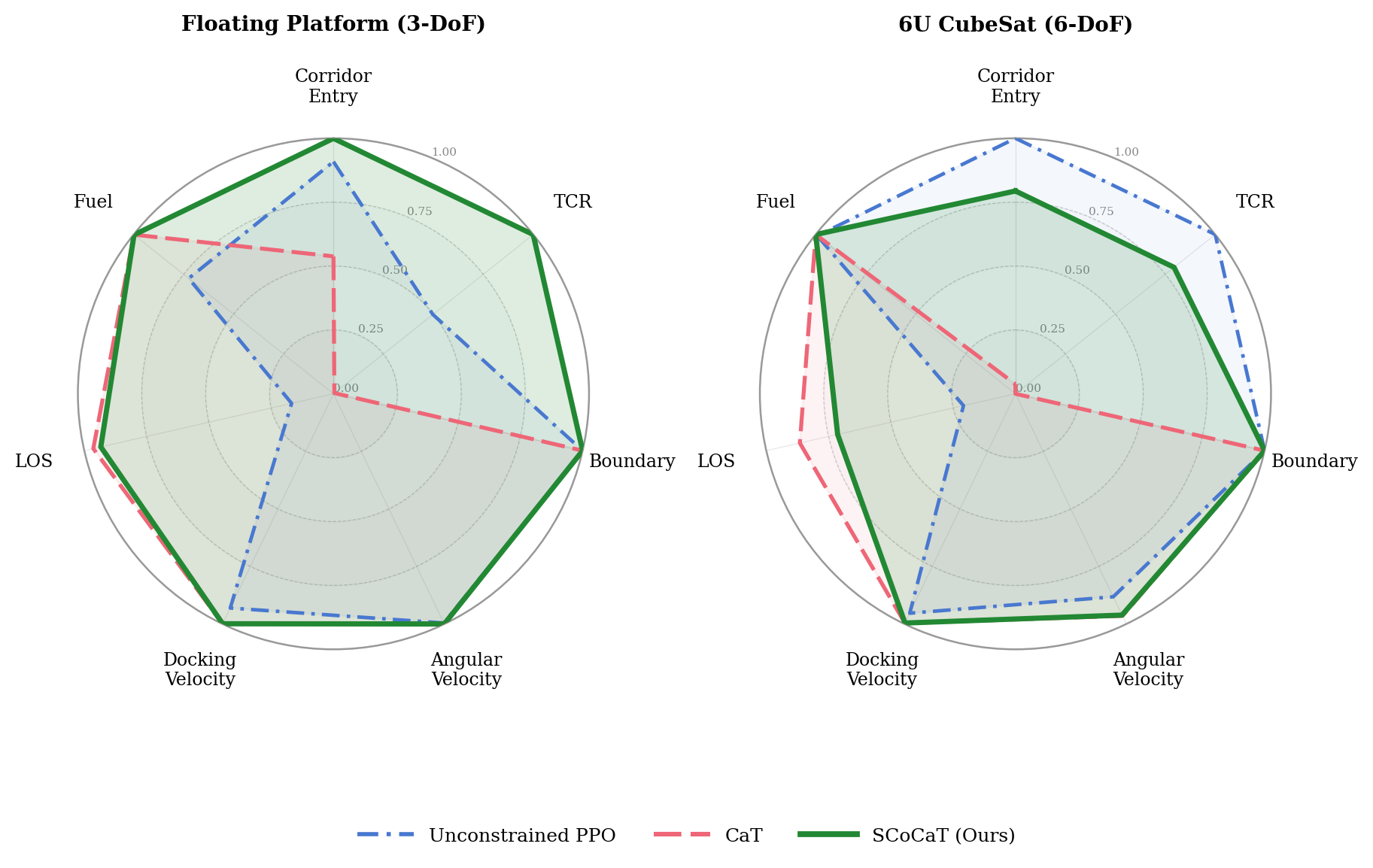
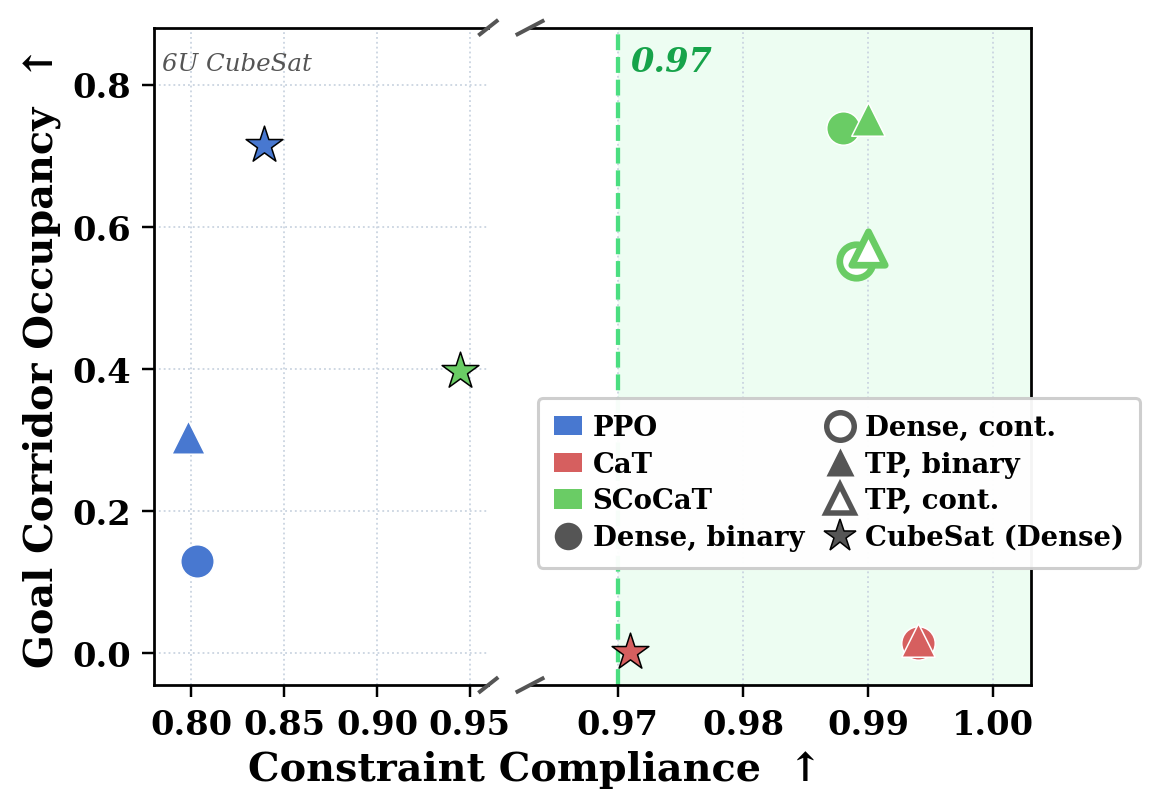
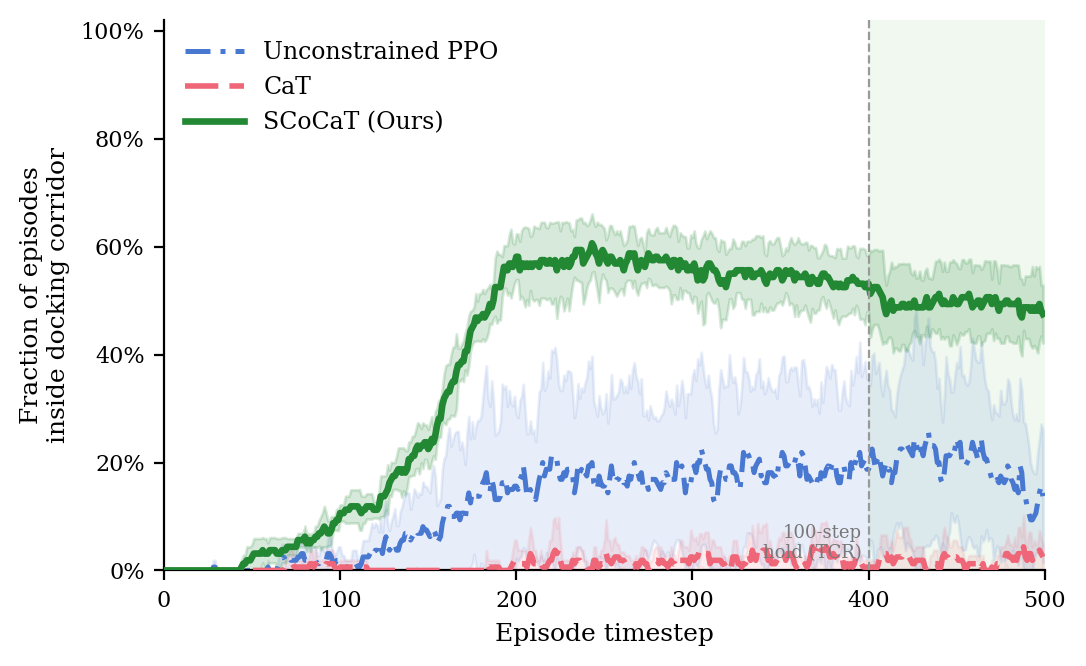
We identify a structural failure mode of this method class on terminal-navigation tasks reaching a precise goal configuration while satisfying safety constraints that tighten along the final approach. When the goal sits inside the region close to where the constraints become active, the survival-weighted objective makes dwelling outside the goal region strictly preferable to entering, producing high constraint compliance with low task completion.
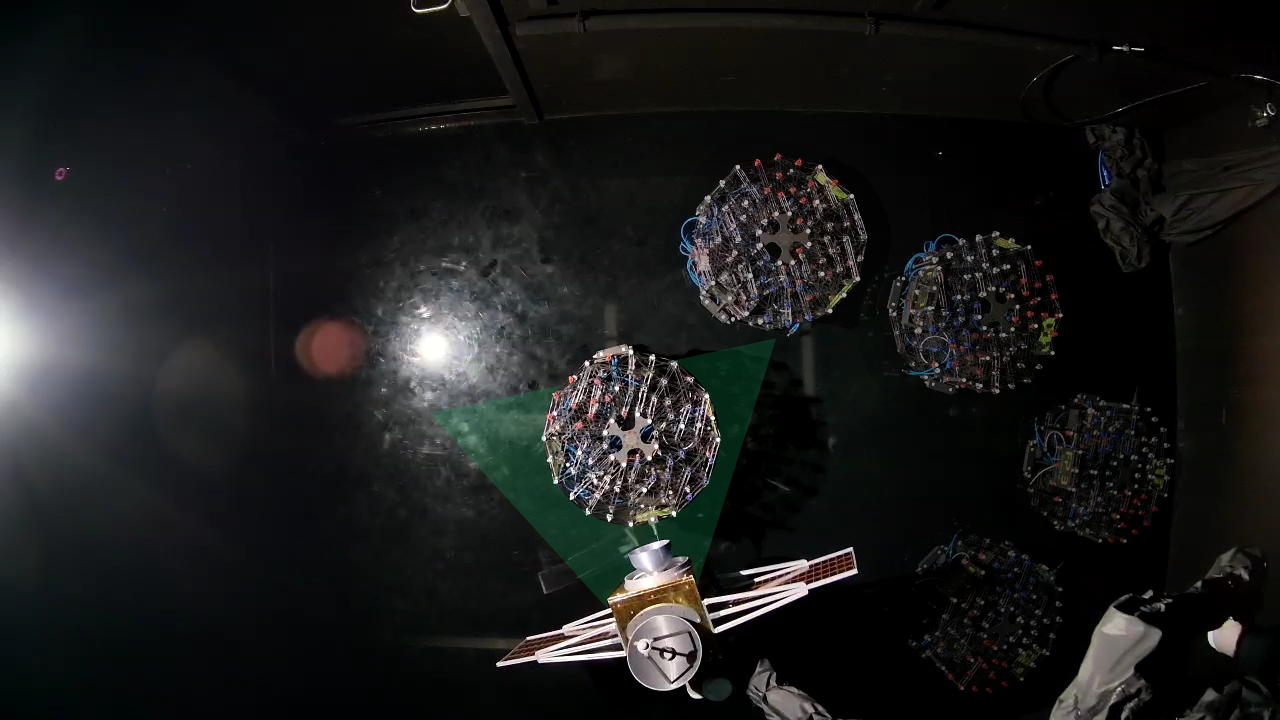
We formalize this pathology and show that a minimal augmentation to off-the-shelf RL algorithms like PPO resolves this “feasibility collapse”. We empirically demonstrate that adding a dense per-step success signal via an auxiliary value critic improves the task completion rate while maintaining safety-critical constraint compliance. Validation across two representative spacecraft platforms—a 6U CubeSat and a floating platform testbed for zero-shot sim-to-real transfer—supports the generality of these findings.
Feasibility collapse in termination-based CRL
Termination-based constrained RL can fail on terminal-navigation tasks when the goal lies inside a constraint-active corridor. CaT may then learn to hover safely outside the goal because entering suppresses its survival-weighted return, producing high constraint compliance without task completion. We derive the condition under which this hover policy becomes preferred. SCoCaT fixes the problem with an auxiliary success critic trained independently of CaT terminations, preserving the learning signal inside the goal corridor while keeping the original constraint mechanism.
Results
We evaluate SCoCaT on a planar floating platform and a 6U CubeSat against unconstrained PPO, CaT, and gradient-projection baselines.
Zero-shot sim-to-real transfer
BibTeX
@inproceedings{arora2026scocat,
  title={SCoCaT: Success Conditioned Constrained Reinforcement Learning for Spacecraft Docking},
  author={Arora, Aman and Marsal I Castan, Ricard and El-Hariry, Matteo and Olivares-Mendez, Miguel},
  booktitle={Conference on Robot Learning (CoRL)},
  year={2026},
}